

 08
08 A Research-Oriented Reflection Inspired by the Discourses of Allama Dr. Shahkh Hami (Hh).
Sheikh Sameer Manzoor:
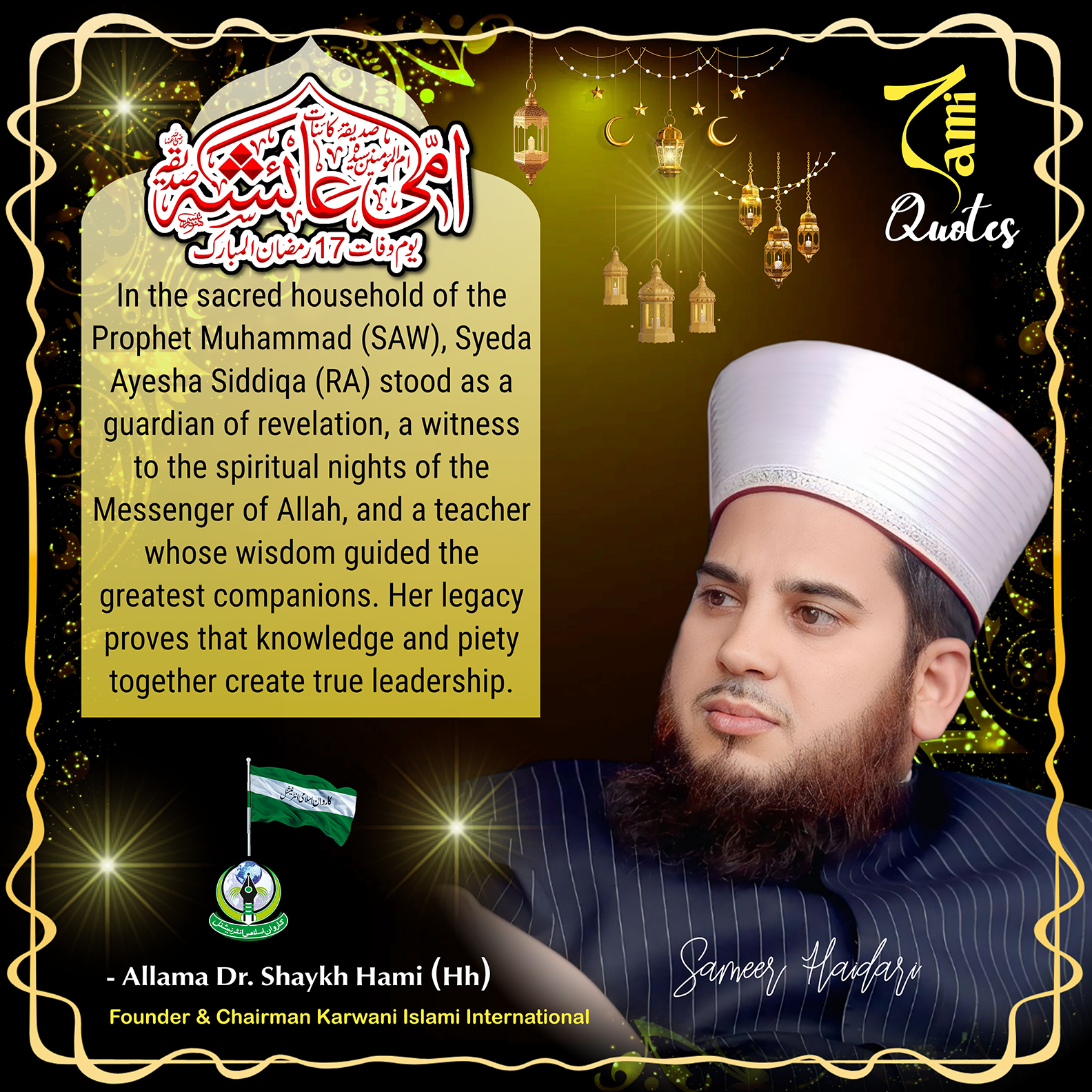
In the intellectual reflections and scholarly discourses of Allama Dr. Shaykh Hami , the personality of Syeda Ayesha Siddiqa (RA) stands among the most luminous figures in the history of Islam. She was not only the beloved wife of Prophet Muhammad ﷺ but also one of the greatest transmitters of prophetic knowledge and an authoritative scholar of the early Muslim community. Shaykh Hami often emphasizes that understanding the life of Ayesha (RA) is essential to understanding the inner dimensions of the Sunnah. Her narrations illuminate aspects of the Prophet’s life that no other companion could observe so closely. The Quran itself establishes the sacred status of the wives of the Prophet ﷺ. Allah states: “The Prophet is closer to the believers than their own selves, and his wives are their mothers” (Quran 33:6). According to the reflections of Shaykh Hami this verse gives Syeda Ayesha (RA) an eternal spiritual rank as Umm al-Muminin (Mother of the Believers). Another verse emphasizes the purity and dignity of the Prophet’s household: “O wives of the Prophet, you are not like any other women if you fear Allah” (Quran 33:32). Shaykh Hami notes that these verses elevate their moral and spiritual responsibility in guiding the Muslim community. Syeda Ayesha (RA) was born into the noble household of Abu Bakar al- Siddiq (RA), one of the closest companions of the Prophet ﷺ. Her father was known as al-Siddiq, the truthful one, whose unwavering faith supported Islam during its earliest and most difficult days. Shaykh Hami often highlights that this environment of truthfulness and sacrifice profoundly shaped the personality of Ayesha (RA). Classical historians such as Ibn Saad in Tabaqat al-Kubra and Ibn Hajar in al-Isabah record that she grew up witnessing the earliest struggles of the Muslim community. The marriage between the Prophet ﷺ and Ayesha (RA) holds deep significance in Islamic history. In the perspective often discussed by him, this marriage was part of divine wisdom intended to preserve the inner teachings of the Prophet ﷺ. The Prophet’s love for her is well documented in authentic hadith. When asked who was most beloved to him, the Prophet ﷺ replied: “Aisha,” and when asked among men, he replied: “Her father.” (Sahih al-Bukhari, Hadith 3662). Shaykh Hami interprets this narration as evidence of the profound trust and affection between the Prophet ﷺ and Ayesha (RA). The affectionate relationship between the Prophet ﷺ and Syeda Ayesha (RA) is recorded in numerous hadiths. She narrates that she used to drink from a vessel and the Prophet ﷺ would place his lips where she had drunk (Sahih Muslim, Hadith 300). Shaykh Hami frequently cites this narration to illustrate the tenderness and emotional warmth within the Prophetic household. These narrations challenge misconceptions about Islamic family life and demonstrate the deep compassion and respect that defined the Prophet’s relationships. One of the greatest contributions of Ayesha (RA) was her role as a witness to the private life of the Prophet ﷺ. Through her narrations, Muslims learned about the Prophet’s worship, humility, and spiritual discipline. She reported that the Prophet ﷺ used to stand in prayer at night until his feet became swollen (Sahih al-Bukhari, Hadith 4837; Sahih Muslim). According to Shaykh Hami , such narrations provide invaluable insight into the spiritual character of the Prophet ﷺ. Syeda Ayesha (RA) is recognized as one of the greatest scholars among the companions. She narrated more than 2,210 hadiths, making her one of the most prolific transmitters of prophetic traditions. Scholars such as Imam al-Zuhri, Imam al-Dhahabi, and Imam al-Nawawi praised her scholarship. He frequently refers to these classical testimonies to demonstrate that Ayesha (RA) was not merely a narrator but also an interpreter of prophetic teachings. The companion Abu Musa al- Ashari once said: “Whenever we companions faced difficulty regarding a hadith, we would ask Aisha and always found knowledge with her” (Jami al-Tirmidhi, Hadith 3883). Shaykh Hami often highlights this statement as evidence of her intellectual authority among the companions. Another defining moment in her life was the Incident of Ifk (false accusation). During this trial, Allah revealed verses in the Quran defending her honor: “Indeed those who came with falsehood are a group among you…” (Quran 24:11-20). He describes this event as one of the greatest examples of divine vindication in Islamic history. Classical tafsir works such as Tafsir Ibn Kathir and Tafsir al-Tabari explain these verses in detail. After the passing of the Prophet ﷺ, Syeda Ayesha (RA) became one of the most important teachers of the Muslim community. Scholars and companions frequently visited her home to learn about hadith and Islamic law. Shaykh Hami describes her residence in Madinah as an early center of Islamic scholarship.
In the scholarly discussions of Shaykh Hami, Syeda Ayesha Siddiqa (RA) is frequently described as one of the earliest jurists of Islam whose legal reasoning shaped the development of Islamic jurisprudence. Her narrations and interpretations became foundational sources for later jurists. Classical scholars report that she issued numerous legal opinions (fatwas) during her lifetime. According to Imam al-Zarkashi in Al-Ijabah fi ma Istadrakat-hu Aisha ala al-Sahabah, Syeda Ayesha corrected several misunderstandings among the companions regarding legal matters and prophetic traditions. Many jurists, including Imam Malik, Imam Abu Hanifa, Imam al-Shafii, and Imam Ahmad ibn Hanbal, relied upon her narrations in matters related to purification, prayer, family law, inheritance, and ethics. He often emphasizes that her jurisprudential authority demonstrates that intellectual leadership in Islam was not limited by gender but rather by knowledge and piety. Her legal insights preserved numerous aspects of the Sunnah that otherwise might have remained unknown. He frequently explains that Syeda Ayesha (RA) served as the most important source for understanding the domestic and personal life of the Prophet ﷺ. While many companions witnessed the Prophet ﷺ in public settings such as the mosque, battlefield, and gatherings, Ayesha (RA) observed his conduct within the household. She narrated details about his humility, compassion, and routine. One famous narration recorded in Sahih al-Bukhari (Hadith 676) states that when asked about the character of the Prophet ﷺ, she replied: “His character was the Quran.” Through her narrations the Ummah learned how the Prophet ﷺ interacted with his family, helped with household tasks, and treated his wives with kindness and dignity. He emphasizes that these narrations are invaluable because they reveal the Prophet ﷺ as the perfect model not only for leadership but also for family life and emotional intelligence. In the academic reflections of Shaykh Hami, Syeda Ayesha (RA) is also recognized for her mastery in Tafsir (Quranic interpretation). Many verses of the Quran were explained through her narrations, especially those related to the life of the Prophet ﷺ and the early Muslim community. For instance, the verses revealed during the Incident of Ifk (Surah al-Nur 24:11-20) were explained extensively through her testimony. Classical exegetes such as Ibn Kathir, al-Tabari, and al-Qurtubi cite her narrations to explain the historical context of these revelations. He often remarks that her proximity to the Prophet ﷺ allowed her to understand the circumstances of revelation with exceptional clarity, making her explanations invaluable for later generations of scholars. The intellectual authority of Syeda Ayesha (RA) among the companions was widely acknowledged. Numerous reports indicate that companions sought her guidance when faced with difficult questions regarding hadith or Islamic law. The companion Abu Musa al- Ashari stated: “Whenever we, the companions of the Messenger of Allah ﷺ, encountered a difficulty concerning a hadith, we would ask Aisha and we always found knowledge with her.” (Jami al-Tirmidhi). He often cites this statement as a powerful testament to her intellectual stature. Even eminent companions recognized her analytical abilities and her profound understanding of the Sunnah. According to the scholarly observations frequently mentioned by Shaykh Hami , Syeda Ayesha (RA) possessed an extraordinary memory and remarkable analytical capacity. Her narrations demonstrate not only precise recall but also critical interpretation. Classical scholars like Imam al-Dhahabi in Siyar Alam al-Nubala describe her as one of the most knowledgeable individuals of her time in matters of hadith, jurisprudence, genealogy, poetry, and medicine. He often emphasizes that her intellectual depth enabled her to explain complex issues and resolve disagreements among scholars. This combination of memory, reasoning, and spiritual insight made her one of the greatest scholars in Islamic history.
Beyond scholarship, Syeda Ayesha (RA) was known for her extraordinary generosity and compassion toward the poor. Historical records describe how she would frequently distribute wealth among the needy and keep very little for herself. In Siyar Alam al-Nubala, Imam al-Dhahabi narrates that she once distributed one hundred thousand dirhams in charity while she herself was fasting and possessed very little for her own sustenance. Shaykh Hami highlights this example to show that her life combined intellectual brilliance with profound spiritual humility and social responsibility. A significant portion of the moral and ethical teachings of Islam comes through the narrations of Syeda Ayesha (RA). Through her reports the Ummah learned about the Prophet’s patience, humility, forgiveness, and kindness. For example, she narrated that the Prophet ﷺ never struck anyone with his hand except in the path of Allah (Sahih Muslim). He frequently notes that such narrations reveal the compassionate character of the Prophet ﷺ and form the foundation for Islamic ethics. In the spiritual teachings of Shaykh Hami , love and respect for Syeda Ayesha Siddiqa (RA) are considered essential elements of the creed of Ahl al-Sunnah wa al-Jamaah. He often reminds his students that honoring the Mothers of the Believers is an expression of love for the Prophet ﷺ himself. Classical Sunni scholars such as Imam al-Tahawi and Imam al-Nawawi emphasized the obligation of respecting all companions and particularly the wives of the Prophet ﷺ. The legacy of Syeda Ayesha (RA) continues to shape Islamic scholarship across centuries. Her narrations appear throughout the major collections of hadith including Sahih al-Bukhari, Sahih Muslim, Sunan Abu Dawud, Jami al-Tirmidhi, and Sunan al-Nasai. Scholars of hadith, jurisprudence, and biography consistently rely upon her narrations when reconstructing the life and teachings of the Prophet ﷺ. According to Shaykh Hami, her intellectual contributions ensured that the inner dimensions of the Sunnah were preserved with clarity and authenticity. In conclusion, the life of Syeda Ayesha Siddiqa (RA) represents a remarkable fusion of scholarship, devotion, courage, and compassion. Through her narrations the Muslim Ummah gained unparalleled insight into the life and teachings of the Prophet ﷺ. As frequently emphasized in the scholarly reflections of him, she remains a timeless beacon of knowledge whose contributions continue to illuminate the intellectual and spiritual heritage of Islam. Her life demonstrates that the preservation of the Prophetic tradition was not the work of men alone but also of extraordinary women whose dedication ensured that the message of Islam would reach future generations with authenticity and clarity.
Research Scholar (KI)
Sheikh Sameer Manzoor.
sheikhsameermanzoor@gmail.com
Copyright 2026 Karwani Islami. Designed By ShivaClicksoft
 English
 Deutsch
 简体中文
简体中文
 العربيّة


