

 18
18 Aitikaf as a Discipline of the Soul: Spiritual, Legal, and Sufi Perspectives in the Teachings of Allama Dr. Shaykh Hami (Hh).
Sheikh Sameer Manzoor.
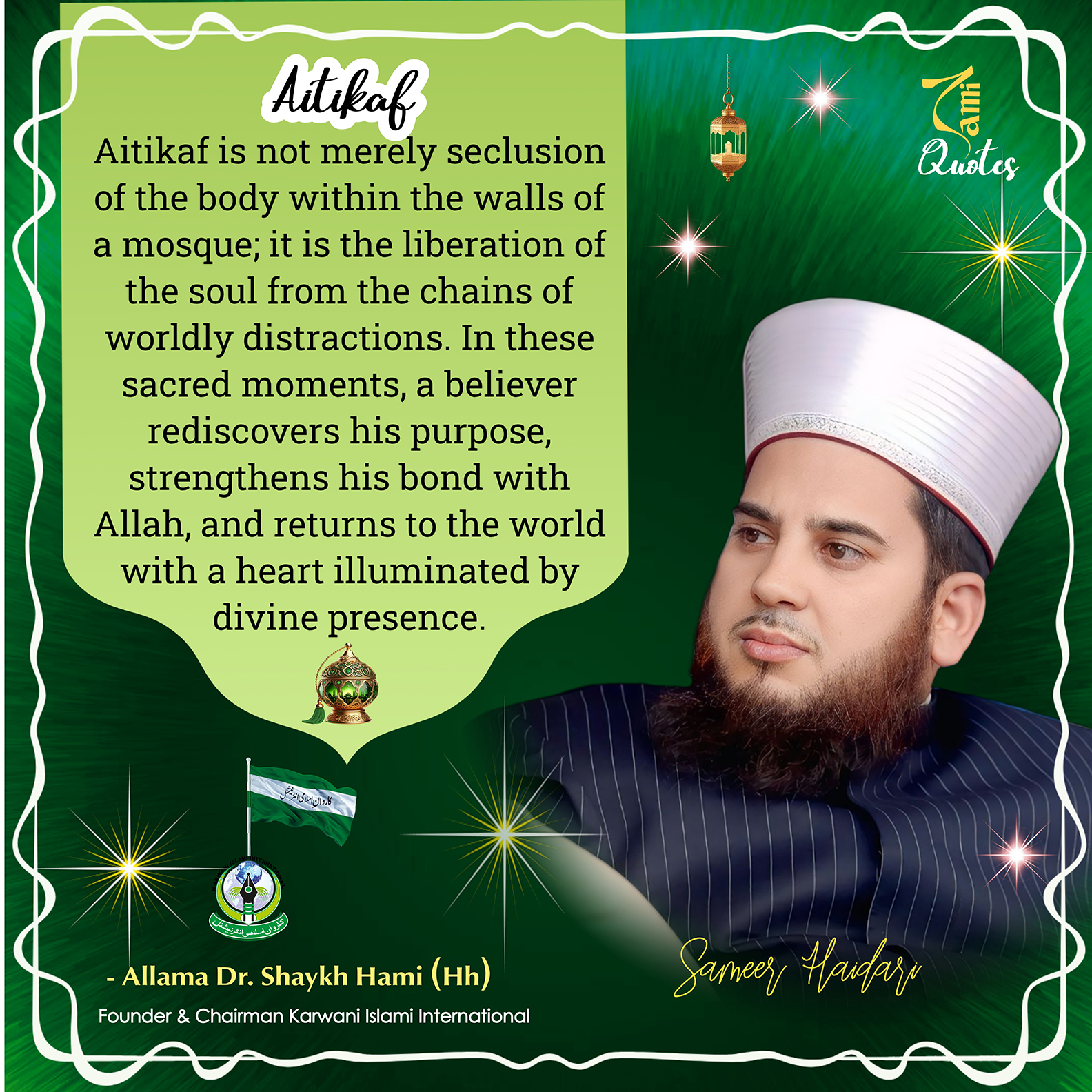
Aitikaf represents one of the most profound institutions of spiritual discipline in Islam, embodying the principle of intentional withdrawal from worldly distractions for the purpose of attaining closeness to Allah. Unlike monastic traditions found in other religious systems, Islam does not endorse permanent withdrawal from society; rather, it introduces Aitikaf as a temporary, structured retreat that occurs within the mosque and within the rhythm of communal life. This practice is most strongly emphasized during the last ten days of Ramadan (Sahih al-Bukhari, Hadith 2026; Sahih Muslim, Hadith 1172), a period already charged with heightened spiritual significance. Through Aitikaf, the believer seeks to disengage from material concerns, social obligations, and personal desires in order to cultivate a state of heightened awareness of Allah. Contemporary Sufi Scholars like Allama Shaykh Hami said that many Scholars throughout Islamic history have described it as a training ground for the heart, a means of restoring spiritual clarity, and a disciplined method for reorienting the human being toward the ultimate purpose of existence, which is the worship and recognition of the Divine (Quran 51:56). The legitimacy of Aitikaf is firmly grounded in the Quran. In Surah al-Baqarah (2:187), Allah states: “Do not approach your wives while you are in retreat in the mosques.” This verse establishes the legal basis of Aitikaf while also indicating its sacred nature and the discipline required during its observance. Allama Shaykh Hami also mentioned that Classical exegetes such as Imam al-Tabari and Imam al-Qurtubi had explained that the mention of Aitikaf in this verse demonstrates that it was already a recognized form of worship among the early Muslim community. Another important verse appears in Surah al-Baqarah (2:125), where Allah commands Prophet Ibrahim (AS) and Prophet Ismail (AS) to purify the Sacred House for those who perform circumambulation and those who remain there in devotion. Allama Shaykh Hami also said that Scholars such as Ibn Kathir interpret the phrase “those who remain there in devotion” as referring to individuals engaged in Aitikaf, thereby linking this practice to the legacy of earlier prophets. These Quranic references establish that Aitikaf is not merely a voluntary act but a divinely sanctioned form of worship embedded within the broader framework of sacred space and ritual devotion. The most detailed and authoritative understanding of Aitikaf comes from the practice of Prophet Muhammad (SAW). Numerous authentic narrations preserved in the major Hadith collections confirm that the Prophet (SAW) consistently observed Aitikaf during the last ten days of Ramadan (Sahih al-Bukhari, Hadith 2026; Sahih Muslim, Hadith 1172). According to a narration recorded in Sahih al-Bukhari (Hadith 2026) and Sahih Muslim (Hadith 1172), Syeda Aisha bint Abu Bakr (RA) reported that the Prophet Muhammad (SAW) continued this practice every year until his passing. This consistency establishes Aitikaf as an emphasized prophetic tradition. Allama Shaykh Hami said that additional narrations indicate that the Prophet initially observed Aitikaf in different periods of Ramadan (Sahih al-Bukhari, Hadith 2044) before ultimately settling on the last ten days. This evolution reflects a process of divine guidance and pedagogical refinement, teaching the Muslim community to focus their efforts on the most spiritually significant portion of the month. An especially significant aspect of the Prophetic practice is the intensification of Aitikaf in the final year of the Prophet’s (SAW) life. According to a narration reported by Abu Hurairah (RA) in Sahih al-Bukhari (Hadith 2044), the Prophet (SAW) observed Aitikaf for twenty days in his last Ramadan instead of the usual ten. Allama Shaykh Hami states that Scholars such as Ibn Hajar al-Asqalani interpret this as an indication of increased spiritual focus and preparation for meeting Allah. This act highlights a broader theological principle: as human beings approach the end of their lives, they are encouraged to increase their devotion and spiritual discipline. Allama Shaykh Hami clearly mentioned that the primary objective of Aitikaf is closely tied to the search for Laylat al-Qadr, described in Surah al-Qadr (97:3) as a night better than a thousand months. The Prophet Muhammad (SAW) instructed his companions to seek this night during the last ten nights of Ramadan (Sahih al-Bukhari, Hadith 2017; Sahih Muslim, Hadith 1169). By remaining in the mosque throughout this period, the believer ensures continuous engagement in worship, thereby maximizing the likelihood of encountering this extraordinary night. Classical scholars such as Imam al-Nawawi explain that Aitikaf provides the ideal environment for seeking Laylat al-Qadr because it eliminates distractions and allows for uninterrupted devotion. Islamic jurists across all major schools of thought agree on the legitimacy and importance of Aitikaf. It is generally classified as an emphasized Sunnah, meaning that it is strongly recommended but not obligatory unless a person makes a formal vow to perform it. Allama Shaykh Hami mentioned that Scholars such as Imam Abu Hanifa, Imam Malik, Imam al-Shafii, and Ahmad ibn Hanbal have all discussed its legal framework in detail, outlining conditions such as intention, location within a mosque (Quran 2:187), and abstention from marital relations. These conditions ensure that Aitikaf remains a disciplined and structured act of worship rather than an informal or symbolic practice. The consensus among jurists highlights the centrality of Aitikaf within Islamic devotional life. In his various Majalis e Zikir Allama Shaykh Hami has mentioned the psychological and spiritual perspective of Aitikaf and how It serves as a powerful mechanism for inner transformation. Human beings are constantly exposed to external stimuli that can lead to distraction, anxiety, and spiritual neglect. By entering a state of seclusion within the mosque, the believer creates a controlled environment in which the heart can be purified and the mind can be focused (Quran 13:28). Classical scholars such as Abu Hamid al-Ghazali emphasize that solitude is essential for self-reflection and spiritual growth. In his seminal work Ihya Ulum al-Din, he explains that excessive social interaction can harden the heart, while periods of seclusion soften it and make it receptive to divine guidance. Aitikaf institutionalizes this principle, providing a balanced approach that combines solitude with communal worship. In many of his lectures Allama Shaykh Hami said that the companions (Suhaba) of the Prophet (SAW) played a crucial role in preserving and transmitting the practice of Aitikaf. Abdullah ibn Umar (RA) is reported to have closely followed the example of the Prophet (SAW) in observing Aitikaf, as documented in Sahih al-Bukhari. His commitment reflects the broader attitude of the companions, who regarded Aitikaf as an essential component of their spiritual lives. Their dedication underscores the importance of continuity in religious practice and demonstrates how the teachings of the Prophet were implemented in the early Muslim community. Syeda Aisha bint Abu Bakr (RA) played a central role in transmitting knowledge about Aitikaf. In addition to narrating the practice of the Prophet, she also reported that his wives continued to observe Aitikaf after his passing, as recorded in Sahih al-Bukhari (Hadith 2026). This continuity highlights the inclusivity of Aitikaf as an act of worship that is accessible to both men and women. Her narrations provide invaluable insight into the practical and spiritual dimensions of this spiritual worship journey (Ibadah). Allama Shaykh Hami always mentioned that the teachings of Ali ibn Abi Talib (AS) emphasize the importance of purifying the heart, which is one of the primary objectives of Aitikaf. He is reported to have said, “Hearts rust just as iron rusts, and their polish is the remembrance of Allah,” a statement preserved in classical collections such as those of al-Bayhaqi (Shuab al-Iman). This teaching aligns closely with the practice of Aitikaf, which immerses the believer in continuous remembrance and reflection (Quran 87:14-15). Through this process, the heart is cleansed of negative qualities and restored to its original state of purity.
Allama Shaykh Hami draws the relation between Syeda Fatima Al Zahra (AS), her pious nature and its resemblance with Aitikaf. He has also mentioned hundreds of times that the life of Fatimah serves as a model of devotion, simplicity, and detachment from worldly concerns. Although specific narrations about her performing Aitikaf are limited or not mentioned, her overall lifestyle embodies the spiritual principles that Aitikaf seeks to cultivate (Quran 33:33). Her emphasis on worship, humility, and reliance on Allah reflects the inner state that believers strive to achieve during this period of seclusion. Abu Hurairah (RA), one of the most prolific narrators of Hadith, reported numerous sayings of the Prophet concerning increased devotion during the last ten nights of Ramadan (Sahih al-Bukhari, Hadith 2015). His narrations emphasize the importance of vigilance, consistency, and sincerity in worship, all of which are central to the practice of Aitikaf. Through his contributions, the broader framework of Ramadan spirituality is preserved. Being a topmost Qadriyyah silsilah preacher and Sufi mystic Allama Shaykh Hami states that Abdul Qadir Jilani (RA), one of the most influential figures in Islamic spirituality, emphasized the importance of seclusion as a means of attaining divine knowledge. In his discourses, he explains that when a servant withdraws from worldly distractions for the sake of Allah, the heart becomes illuminated with spiritual insight. This perspective aligns closely with the objectives of Aitikaf, which seeks to create the conditions necessary for such illumination. Al-Ghazali provides one of the most comprehensive analyses of spiritual discipline in Islamic thought. He argues that periods of seclusion are essential for breaking habitual patterns of distraction and for cultivating mindfulness of Allah (Quran 7:205). His analysis offers a theoretical framework for understanding the deeper significance of Aitikaf beyond its legal and ritual aspects. Allama Shaykh Hami has described that one of the most important outcomes of Aitikaf is the transformation of character. Islamic teachings emphasize that acts of worship should lead to ethical improvement, and Aitikaf is no exception. By engaging in continuous prayer, reflection, and remembrance, the believer develops qualities such as patience, humility, and sincerity (Quran 91:9–10). These qualities are essential for personal growth and for the well-being of society as a whole. Although Aitikaf is an individual act of worship, its effects extend beyond the individual to the broader community. A person who emerges from it with a purified heart and renewed sense of purpose is better equipped to contribute positively to society (Quran 3:110). Allama Shaykh Hami has quoted that “Islamic history demonstrates that spiritual reform often precedes social reform, and Aitikaf plays a key role in this process”. The continuation of Aitikaf by the wives of the Prophet after his passing, as reported by Aisha bint Abu Bakr (RA) in Sahih al-Bukhari (Hadith 2026), demonstrates that this practice is not limited by gender. It highlights the inclusive nature of Islamic worship and the importance of providing opportunities for spiritual growth to all members of the community. In the modern world, where individuals are constantly connected to technology and social obligations, the need for structured spiritual retreat is greater than ever. Aitikaf offers a unique opportunity to disconnect from these distractions and to focus on personal growth and spiritual development (Quran 59:19). Its relevance extends beyond the confines of traditional religious practice, offering insights into mental well-being and emotional resilience. In the intellectual tradition associated with Allama Dr. Shaykh Hami, Aitikaf is understood as a transformative experience that begins with individual reflection and extends to societal change. It is described as a process through which the believer reconnects with the core values of faith and prepares to engage with the world in a more meaningful and responsible way and in conclusion he said that Atikaaf is a comprehensive act of worship that integrates legal discipline, spiritual reflection, and ethical transformation. Rooted in the Quran (2:187), exemplified by the Prophet (SAW) (Sahih al-Bukhari, Hadith 2026), and elaborated upon by scholars and spiritual masters, it remains one of the most powerful means of attaining closeness to Allah. Its enduring relevance lies in its ability to address the fundamental needs of the human soul, offering a path toward inner peace, moral integrity, and ultimate success (Quran 89:27–30).
Research Scholar (KI)
Sheikh Sameer Manzoor
sheikhsameermanzoor@gmail.com
Copyright 2026 Karwani Islami. Designed By ShivaClicksoft
 English
 Deutsch
 简体中文
简体中文
 العربيّة


